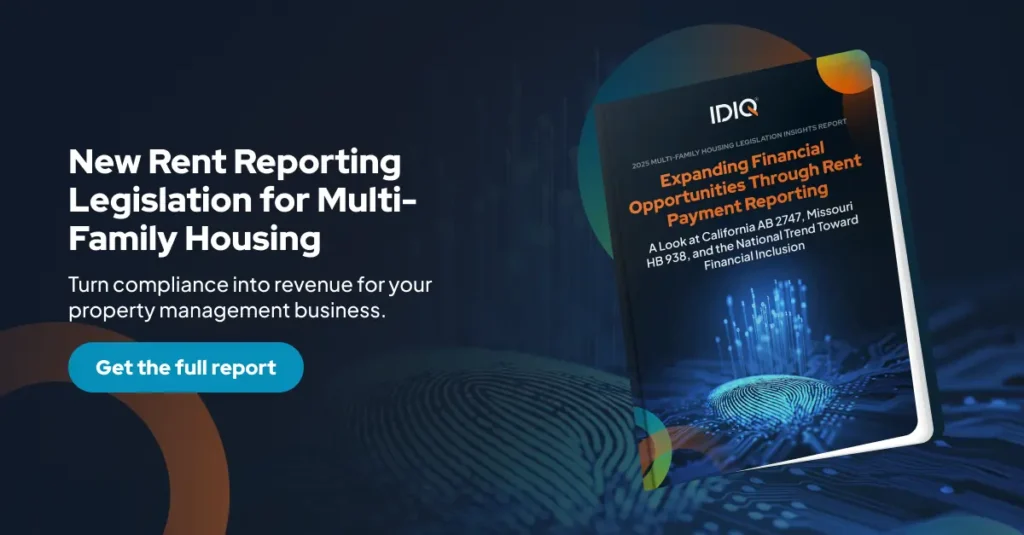






California property management companies face a new operational reality.
Effective July 1, 2025, California Assembly Bill 2747 requires property owners and managers of multifamily communities to offer residents the option to report their on-time rent payments to a major credit bureau.
At a high level, the law is easy enough to understand; the harder part is building a repeatable process around it.
For property management companies, the challenge comes in implementation. Teams already managing a long list of responsibilities must determine how to implement this additional process in a compliant, efficient, and realistic way.
That means managing annual notices, resident elections, signature collection, bureau reporting responsibilities, and onsite support across multiple properties and lease cycles.
For many property management companies, AB 2747 is less a policy question than a workflow question: how do you support compliance without creating a new burden for teams?
In this guide, you’ll learn:
- Why AB 2747 is creating new pressure for property management companies
- What the law requires
- Where implementation tends to get complicated
- How a turnkey model can make compliance easier to manage
AB 2747: What Property Management Companies Need to Know
AB 2747 requires property owners and managers with 16 units or more to offer residents the option to report on-time rent payments to at least one major credit bureau, including Experian, Equifax, or TransUnion.
Participation is optional - residents can choose whether or not to take part.
Property managers are responsible for making sure any rent data that is reported is accurate and submitted on time.
For new leases entered on or after April 1, 2025, the offer must be made at signing and then at least once every year following.
For existing leases, the offer must be made by April 1, 2025, then annually moving forward.
In other words, AB 2747 is not a one-time communication requirement. It creates an ongoing process that property management companies need to be prepared to manage consistently.
Why AB 2747 Gets More Complicated in Practice
The communication requirements matter just as much as the reporting requirements.
Notices must include specific required information, and they can be sent by email or first-class mail.
If an email is not successfully sent and the notice is sent by mail, the landlord must include a self-addressed, stamped envelope so residents can return the election form.
While these requirements sound straightforward, it requires a process that has to work across multiple properties, residents, staff members, and systems.
This is where the operational burden starts to creep in. Non-compliance can create regulatory risk, but it can also create additional friction for property teams and residents alike.
Why Property Management Companies Hesitate to Manage Rent Reporting Internally
For many property managers, the question isn’t whether or not it’s worth it to provide rent reporting to their residents. The harder questions are the ones that follow:
- Do we have bandwidth for this?
- Who can manage the communication around it?
- How do we track resident elections accurately?
- What happens if notices fail to deliver?
- Who handles reporting responsibilities?
- How much extra work does this create?
At the same time, many property management companies recognize that rent reporting can support resident financial wellness, and strengthen the overall resident experience - especially when the program is managed well.
When rent reporting feels like just another compliance program layered onto property operations, even organizations that are interested in it may stall.
And it’s not because they don’t see the value - it’s that they only see the workload attached to it.
The Workflow Gaps That Make AB 2747 Harder to Manage Internally
On paper, AB 2747 looks like a simple resident benefit: give renters the option to have on-time payments reported. But when you try to run it across multiple properties, lease start dates, and communication channels, the work quickly breaks into a series of operational gaps that most teams are not staffed or tooled to manage consistently.
Annual Compliance Notifications
AB 2747 creates an ongoing obligation to offer rent reporting at the right times and in the right way. That means notices need to be generated, delivered, and documented consistently across lease cycles and properties.
Without a standardized process, that can quickly turn into another manual workflow for teams that are already stretched thin.
When that process depends on internal tracking, consistency becomes harder to maintain, especially as properties and lease activities scale.
Resident Communication Gaps
While a quick email can work for many residents, it is not a one-size-fits-all solution. Some residents may not have an email address on file. Some residents may miss or misunderstand the notice. As those exceptions start piling up, compliance becomes much harder to manage at scale.
And when first-class mail is the fallback, that means cost and coordination need an increase. This is one of the first places where a simple compliance requirement starts to turn into a heavier operational process.
Enrollment Tracking Gets Complex Quickly
Rent reporting may sound straightforward, but understanding who received the offer, who enrolled, what they agreed to, and how that information is stored and maintained can be complicated.
When multiple communities are involved, it can quickly become a messy administrative issue without proper structure in place.
Consent Collection and Record Keeping After
A rent reporting offer is not just for awareness; it requires written election with specific pieces of information. That means property management companies need a dependable way to collect, store, and retrieve consent records.
Precise record keeping is key when teams need to verify tenant elections, answer their questions, or document compliance down the line.
Bureau Reporting Introduces Risk
Many property management companies are hesitant to take on the responsibility of sending data to credit bureaus, as they are not typically data furnishers or aggregators and often lack in-house expertise in reporting standards, data reconciliation, reporting timelines, and dispute resolution.
As a result, many are reluctant to build and manage these internal processes on their own.
Onsite Teams Need Support
Even if the corporate team owns the decision, onsite teams are the ones feeling the impact first. They’re the ones fielding resident questions, handling confusion around enrollment, or managing follow-up about how the program works.
If they do not have clear guidance, the program can create more friction at the property level than expected.
This is why education and support are just as critical as the reporting mechanics themselves.
A workable model should do more than ensure compliance - it should also prevent on-site teams from being burdened with unnecessary processes while providing residents with a clear and straightforward experience.
A Practical Rent Reporting Solution Can Help
Property management companies need a model that makes compliance easier to execute in practice.
A practical rent reporting solution should support:
- Resident notifications
- Consent capture
- Election tracking and record keeping
- Accurate bureau reporting
- Resident support
- Seamless integration with existing property management systems if possible
Most importantly, it should reduce manual workload for both corporate and on-site teams, rather than simply serving as a compliance checkbox.
How IDIQ Helps Reduce the Lift
IDIQ helps property management companies simplify the process. With a turnkey rent reporting solution designed to support AB 2747 implementation, IDIQ reduces the amount of process-building property management companies have to take on internally.
IDIQ manages the parts of the process that many companies do not want to own internally, including:
- Resident enrollment
- Credit bureau reporting
- Ongoing customer support
To make implementation easier, IDIQ supports integration with major property management systems, helping reduce friction during rollout.
Instead of asking property teams to build a reporting operation from scratch, IDIQ gives them a more practical path to launch and sustain rent reporting with less internal strain.
Important Program Note: Direct Opt-In vs. Lease Enroll
Program structure matters as it has a direct impact on workload, adoption, and long-term sustainability.
For property managers offering rent reporting as a direct opt-in program, IDIQ charges an annual platform fee to support program sustainability. This is because direct opt-in programs require significant effort, including onboarding, data management and reconciliation, and ongoing resident support.
Property management companies that launch rent reporting through lease enroll with opt-out participation do not need to pay an annual platform fee. Adoption rates for an opt-out system are in the 80 to 90% range, meaning the program is generally more efficient to support operationally.
This is an important distinction for property managers to evaluate how to roll out rent reporting. The structure of the program does not just affect participation; it affects total lift, cost, and long-term sustainability.
Final Notes
Annual notices, reporting responsibilities, and ongoing education can turn rental payment reporting into a much heavier lift than property management companies might initially expect.
That is why implementation matters so much. The best rent reporting programs are compliant on paper, of course, but they are built to work in practice without overly burdening the teams responsible for carrying them out.
IDIQ helps property management companies support AB 2747 compliance without taking on all of the operational burden themselves.
Want to simplify your rent payment reporting and ensure compliance? Partner with IDIQ today!

The Summer Travel Risk That Your Advisor Isn’t Watching For
About the author: Danielle Guadeloupe-Rojas is in charge of business development at Redacted by IDIQ. This service offers identity protection tailored for executives and wealthy families. She collaborates closely with wealth advisors, family offices, and senior leaders to address the protection gaps that typical identity monitoring overlooks. Her experiences in this role inspired her to write this.
I work with a lot of successful people. High net worth families, senior executives, people who’ve built real wealth and built it carefully so that they can leave a legacy behind.
Almost all of them tell me the same thing: they’re “incredibly mindful about their financial lives.”
They monitor their investments, review their tax documents quarterly, and know exactly what’s happening with their accounts. They have advisors, attorneys, CPAs; a full advisory team acting as a village of protection.
But there’s one window where that vigilance completely disappears, and the fraud actors know exactly when it is: summer travel season.
The Pattern Nobody Talks About
I’ve watched this pattern play out enough times to know it’s not a coincidence. You leave for a week in the Hamptons or a month abroad, and while you’re managing client meetings or just trying to have time with your family, someone is filing a change of address on your mail. Opening new financial accounts in your name. Taking out loans against property you own.
And here’s the thing nobody talks about: you won’t see it happen. You won’t see it until weeks later, when it’s already done and you’re back from vacation.
The gap isn’t on your end. The gap is that absence creates predictability, and predictability is what fraud actors are designed to exploit.
Why Is Summer Different?
The data backs this up. According to Deloitte’s Family Office Cybersecurity Report, 57% of North American family offices have suffered a cyberattack in the past two years. For high net worth families with assets spread across properties, financial accounts, and advisory relationships, the attack surface is exponentially larger than for the average consumer. But the real number that matters is timing.
Summer isn’t random. It’s predictable. And predictable is exactly what fraud actors are waiting for.
Here’s what actually happens:
Your Mail Becomes a Vulnerability
When you’re traveling, you’re not opening mail. You’re not checking your credit card statements in real time. You’re definitely not reviewing loan applications against properties you own. Financial alerts go to an email address you’re not monitoring because you’re 5,000 miles away.
A fraudulent loan application filed against your home while you’re out of state surfaces two months later when a lender calls about a missed payment. By then, the damage is done. By then, months have passed. And in identity theft, months is the difference between something contained and something that’s going to cost you 200+ hours of your time to fix.
One of the easiest things a fraud actor can do is file a USPS change of address form. It takes five minutes online. Now your bank statements, credit offers, tax documents, everything, it’s all going somewhere else. They now have the raw material to open accounts, take out loans, and access financial information.
This isn’t theoretical. The Department of Justice documented exactly this scenario in a $1.5 million property fraud case in Burbank, California, in February 2026. A real estate broker and her co-conspirators used stolen identities to forge documents, take out a near $1 million loan against the property, and sell a home the owner still owned without their knowledge.
Your Property Is Vulnerable
If you own a second home, a vacation property, or investment real estate across multiple states, this gets worse. Each property has its own mail stream, its own title records, and its own loan documentation.
A criminal doesn’t need to compromise your primary residence. They need to target one property you’re paying less attention to and suddenly a fraudulent lien is filed against a rental property in a state you visit twice a year. You won’t see it until you try to refinance or sell.
By then, a fraudulent mechanic’s lien may have already been filed against a rental property in a state you visit twice a year. You won’t see it until you try to refinance or sell. According to the Los Angeles County District Attorney, a single California scheme in 2026 resulted in $568 million in false mechanic’s liens filed against 10 properties across Los Angeles County. Multiple families. Same scheme.
Why This Is Different When It’s Your Life
Here’s what I’ve learned talking to the people I work with: not all identity theft is equal. For most people, it’s a financial problem. A disputed charge. A damaged credit score. Some phone calls with the credit card company.
For you, it’s different.
The Reputational Piece Is Real
We have a client, a senior executive at a major firm, who discovered during a routine investment background check that someone had opened a $30,000 line of credit in his name. Using his credentials and good credit, the criminals got approved. A criminal judgment was already issued before he even knew it happened. The data came entirely from the dark web, sitting in open databases he didn’t know existed.
Think about what happens to your professional reputation when:
- An investment background check flags fraudulent accounts
- A lawsuit names you as the defendant in a case you never heard about
- A business deal falls apart because your credit profile suddenly shows accounts you never opened
That’s not just a financial problem. That’s a career problem. That’s a reputation problem. And it’s exponentially worse if you don’t catch it until months after it happened.
The Time Cost Is Brutal
According to the Federal Trade Commission, identity theft restoration takes an average of 200 hours of active work and six months to resolve. For executives and high net worth individuals with complex financial lives spanning multiple properties, accounts, and entities, that timeline stretches further. Not just phone calls. Actual work.
That means coordinating with the FTC, working with your attorney, filing police reports, dealing with the IRS if fraudulent tax documents are involved, managing lenders across multiple properties. It’s a full scale incident response operation.
And it always, always, happens right when you can’t afford the distraction. Right when you’re in the middle of managing something major at work.
Your Family Is Vulnerable Too
Your spouse and your adult children travel independently. Same with your parents. They’re all targets. According to research by Carnegie Mellon University CyLab, reported by Forbes, children are 51 times more likely to become identity theft victims than adults.
And if fraud happens to a family member while you’re all traveling together, while you’re supposed to be on vacation, that becomes your problem to manage. That becomes the incident you have to coordinate across multiple people, multiple financial institutions, multiple family dynamics.
The Gap in What Everyone Tells You
Your advisors, your wealth manager, your CPA, even your attorney have told you to protect yourself.
These are all reasonable things. But here’s what I’m seeing: people do all of these things, and they still get hit during summer travel. Because all of these approaches are reactive. They catch the problem after it’s already active. After the account is opened. After the loan application went through. After the mail got rerouted and someone had access to your financial information for three months.
You can’t afford reactive. What you actually need is someone watching before something happens.
Someone who knows you own three properties across two states. Someone who knows which financial institutions you actually work with, so they can spot when a new institution pops up with an application in your name. Someone who sees a change of address filing and stops it before your mail goes anywhere. Someone who notices an attempted loan application and intervenes before it gets approved.
Someone who is actively monitoring your exposure while you’re traveling.
This is what Redacted by IDIQ does.
The Solution: Proactive Monitoring and a Dedicated Protector
Monitoring and prevention are the first line of defense. Redacted by IDIQ offers:
- 24/7 monitoring across 100+ threat vectors: USPS filings, new loan applications, VIN numbers, medical IDs, global criminal records, dark web activity, and data broker exposure
- $2M in identity theft insurance (underwritten by AIG and American Bankers)¹
- $1M in residential property title warranty
Do I think you’ll need them? If the monitoring is working right, you shouldn’t. But if something significant does get through, those protections are there.
The real protection is the person watching. Not the insurance policy.
Why a Dedicated Identity Intelligence Officer?
This person is called a dedicated Identity Intelligence Officer (IIO), and it’s what makes Redacted by IDIQ one of a kind.
You call your Identity Intelligence Officer before you leave for summer travel. You tell them where you’re going, how long you’ll be gone, what properties you own and where, what financial accounts are active. They now have your complete asset protection picture.
While you’re in the Hamptons for July and August, your IIO is actively watching whether anyone has filed a change of address on your mail in Maryland. They’re monitoring whether someone tried to file a new lien against your rental property in Florida. They’re looking at your financial accounts for unauthorized access. They’re monitoring the dark web and data brokers for your personal information.
If something surfaces, your IIO doesn’t send you an alert and make you handle it from the beach. They investigate. They call the relevant institutions. They coordinate the response. Often, you don’t hear about it at all because they handled it before it became a problem.
And this covers your whole family. Your spouse, your adult children, your parents.
This is what proactive protection actually looks like. Not something you monitor. Something that’s monitoring on your behalf and for your family. Not a dashboard. Not a service you check or an alert you get. Don’t worry about it because it’s handled.
What Actually Works: Six Things to Do Before You Travel
If you’re going to travel this summer, here’s what actually works:
- Tell someone in your trusted village that you’re traveling. Don’t post it publicly on social media, but your advisor, your office, your trusted inner circle should know you’ll be unavailable.
- Check your USPS account before you leave. Log into USPS.com and verify no change of address requests are pending. It takes three minutes and could save you months of headache.
- Know which accounts and documents are in motion. Are you closing on a property? Refinancing? Applying for credit? Know what’s actually moving so you can track it. Don’t assume you’ll remember what you started before you left.
- Designate someone else to make decisions if something comes up. Give one trusted person (attorney, family office manager, someone) limited power of attorney or the ability to act on your behalf if a time sensitive issue surfaces while you’re gone.
- Set up dedicated monitoring on every property and asset you own. Each property should have dedicated monitoring. Each account. Not just alerts. Actual monitoring.
- Sign up for Redacted by IDIQ. Before your plane takes off.
The Question to Ask Your Advisor Right Now
Before you leave this summer, call your wealth advisor, your CPA, your attorney.
Ask them: Who is actively monitoring my identity while I’m traveling?
Do not wait to check after something goes wrong. Ask actively, right now, before it happens. And if something does happen, who manages the full resolution?
Most advisors I talk to don’t have a clean answer to this question. That gap is exactly what I see exploited every summer, and you’ve worked way too hard to have that happen to you.
The Best Time to Act Is Now
The best time to set this up isn’t when you’re packing your bags. It’s now. It’s before you book your plane tickets for a month on the French Riviera before the kids go back to school. And it shouldn’t be something you’re managing yourself.
It should be a service and a person: Someone assigned to your protection, someone you know, someone who already understands your financial life and is actively working on your behalf while you’re living yours. Your wealth advisor, your family office, your benefits department, this is someone who works with your advisory circle and village.
In the meantime: travel, be fully present with your loved ones during these hot summer days and let someone else watch the exposure that you can’t.
That’s what actual protection looks like with Redacted by IDIQ.
Redacted is a concierge-level identity protection service for executives and affluent families. Redacted is a service of IDIQ, which has helped protect over 6 million members since 2009.
For more information, visit www.redacted.me.
¹ Identity theft insurance underwritten by AIG and American Bankers. For full terms and conditions, visit redacted.me